
Lead Management Process: Capture to Close Guide
Guide
June 25, 2026
261 views
Super Admin
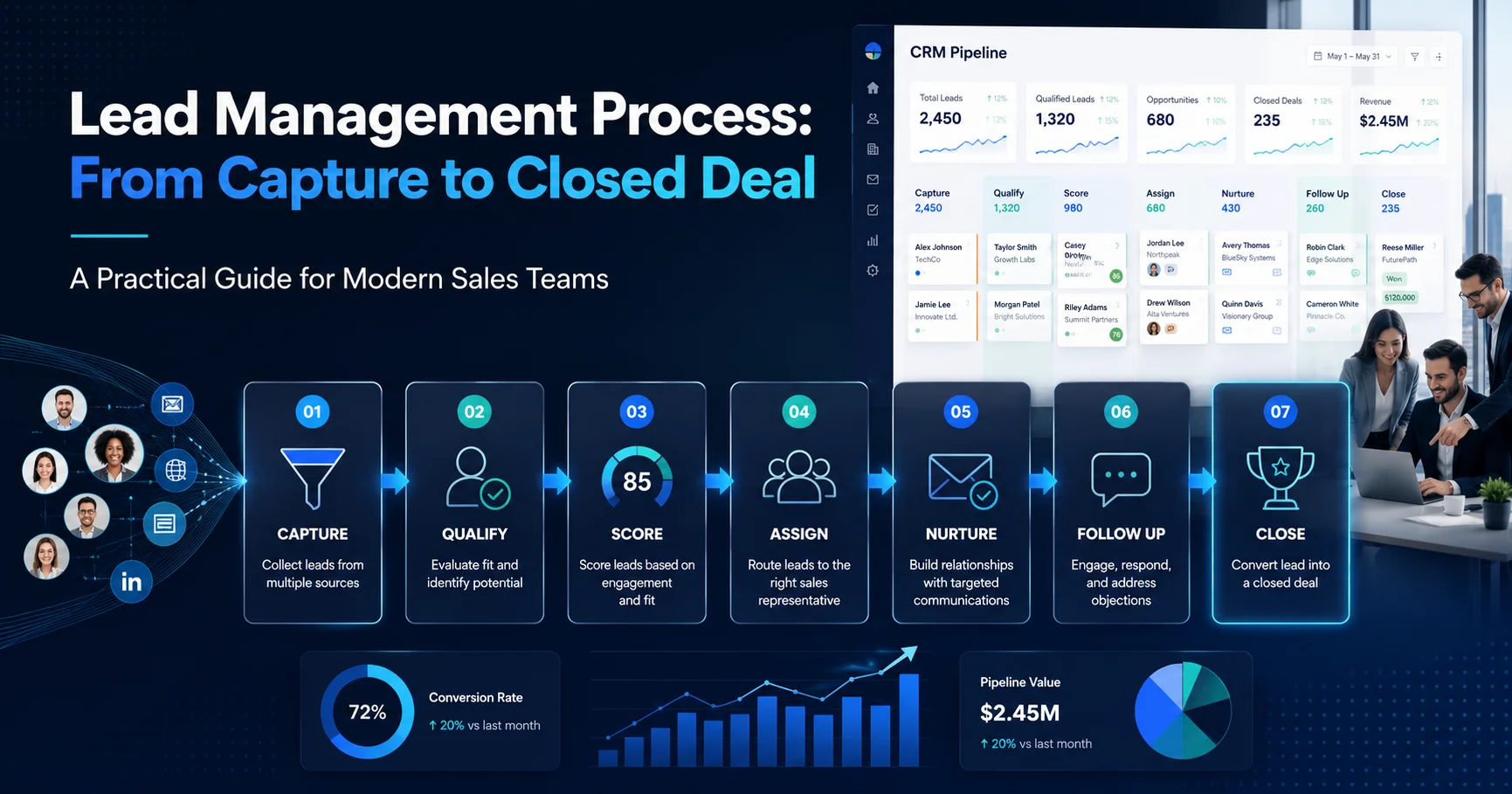
A strong lead management process helps businesses capture, qualify, track, nurture, and convert leads without losing opportunities. This guide explains the complete flow from first contact to closed deal, with practical CRM workflows, lead scoring methods, follow-up strategies, common mistakes, and best practices for modern sales teams.
A lead is not just a name in a spreadsheet.
It is a potential customer with a problem, a need, a budget, a timeline, and a decision journey. The real challenge for most businesses is not only generating leads. It is managing those leads properly from the first interaction until the deal is closed.
That is where a clear lead management process becomes essential.
Many businesses spend heavily on ads, SEO, referrals, events, email campaigns, social media, and sales outreach, but still lose revenue because leads are not captured correctly, assigned quickly, followed up consistently, or nurtured with the right message. A lead may fill out a form today, speak to a sales representative tomorrow, go silent for two weeks, return with a buying question, and then choose a competitor simply because the competitor responded faster and tracked the conversation better.
The difference between a lost lead and a closed deal often comes down to process.
A strong lead management process helps your sales and marketing teams work from the same system, understand lead quality, prioritize the right opportunities, automate repetitive follow-ups, and move prospects through the pipeline with clarity. It gives your business control over every stage of the buyer journey.
This guide explains the complete lead management process from capture to closed deal. It covers lead capture, qualification, scoring, assignment, nurturing, follow-up, opportunity management, closing, post-sale relationship management, CRM workflows, B2B examples, sales best practices, common mistakes, and future trends.
By the end, you will understand how to build a practical lead management process flow that improves conversions, shortens sales cycles, and reduces lead leakage.
What Is the Lead Management Process?
The lead management process is the structured method a business uses to capture, organize, qualify, score, assign, nurture, track, and convert potential customers into paying clients. It connects marketing and sales activities so every lead is followed up properly, prioritized based on value, and moved through the sales pipeline with clear next steps.
In simple terms, lead management answers five important questions:
Who is the lead?
Where did the lead come from?
How interested and qualified is the lead?
Who should follow up?
What needs to happen next to turn the lead into a customer?
Without this process, leads become scattered across forms, inboxes, WhatsApp messages, spreadsheets, call logs, social media DMs, and individual salespeople’s memories. That creates confusion, duplicate work, slow responses, and missed opportunities.
A proper lead management process creates one organized path from first contact to closed deal.
Why Lead Management Matters for Business Growth
Lead generation gets attention, but lead management drives revenue.
A company can generate hundreds of leads every month and still struggle to grow if those leads are poorly handled. The problem is not always traffic, ads, or demand. In many cases, the problem is operational.
Leads are not contacted quickly enough.
Sales teams do not know which leads are ready to buy.
Marketing keeps sending unqualified contacts to sales.
Follow-ups are forgotten.
Pipeline stages are unclear.
Managers cannot see where deals are stuck.
Customer data is scattered across different tools.
A lead management process solves these problems by creating structure.
When your process is clear, each lead has a defined status, source, owner, priority level, next action, and pipeline stage. Sales representatives know who to contact first. Managers can see conversion rates at each stage. Marketing can identify which campaigns bring quality leads. Business owners can forecast revenue more accurately.
For growing businesses, lead management is not optional. It becomes the operating system for revenue.
The Business Impact of Poor Lead Management
Poor lead management creates hidden revenue loss. The business may look busy, but the sales system is leaking opportunities.
Common signs include:
Leads are generated but not contacted.
Sales representatives follow up only with the easiest leads.
High-intent inquiries are mixed with low-quality contacts.
The same lead is contacted by multiple team members.
No one knows which campaign produced the best customers.
Follow-up conversations are not recorded.
Sales managers rely on verbal updates instead of pipeline data.
Deals stay in the same stage for weeks without action.
Customers repeat information because the team lacks history.
Marketing and sales blame each other for poor conversion.
This is not just a sales problem. It affects customer experience, marketing ROI, team productivity, cash flow, and long-term growth.
The Business Impact of Strong Lead Management
A strong process creates the opposite effect.
Teams respond faster. Leads are routed to the right person. Sales conversations become more relevant. Marketing campaigns become easier to measure. Managers can identify bottlenecks. Forecasting becomes more reliable. Customers feel understood because previous interactions are tracked.
A good lead management process helps businesses:
Improve lead response speed
Increase conversion rates
Reduce missed follow-ups
Prioritize high-value opportunities
Align sales and marketing teams
Improve customer experience
Shorten sales cycles
Track campaign performance
Build repeatable sales workflows
Scale without losing control
The goal is not to make the process complicated. The goal is to make it consistent.
Lead Management Process Flow Explained
A lead management process flow is the step-by-step journey a lead follows from initial capture to final conversion. It shows how leads enter the business, how they are evaluated, how they are assigned, how they are nurtured, and how they become customers.
A typical lead management process flow looks like this:
Stage | Purpose | Main Activity | Owner |
Lead capture | Collect lead information | Forms, calls, ads, landing pages, referrals, chat, events | Marketing / Sales |
Lead enrichment | Add useful context | Source, company, industry, interest, budget, location | Marketing / CRM |
Lead qualification | Decide if the lead is worth pursuing | Fit, need, budget, authority, timeline | Sales / SDR |
Lead scoring | Prioritize leads | Assign points based on behavior and profile | Marketing / Sales Ops |
Lead assignment | Give lead to the right person | Route by territory, product, priority, or team | Sales Manager / CRM |
Lead nurturing | Build interest and trust | Emails, calls, demos, content, retargeting | Marketing / Sales |
Sales follow-up | Engage directly | Discovery call, proposal, meeting, objection handling | Sales |
Opportunity management | Manage active deal | Pipeline stage, quote, task, negotiation | Sales |
Closing | Convert lead into customer | Agreement, payment, onboarding | Sales / Finance |
Post-sale management | Build retention | Handoff, support, upsell, relationship tracking | Customer Success |
The process should not be treated as a rigid one-way path. Real buyers move back and forth. Some leads are ready to buy immediately. Others need months of education. Some become opportunities, go cold, and return later. A good CRM lead management process keeps all of this history connected.
Stages of a Modern Lead Management Process
A modern lead management process is more than collecting names and making calls. It combines strategy, data, automation, human judgment, and customer experience.
The main stages are:
Lead capture
Lead enrichment
Lead qualification
Lead scoring
Lead segmentation
Lead assignment
Lead nurturing
Sales follow-up
Opportunity management
Deal closing
Post-sale relationship management
Reporting and optimization
Each stage has a different purpose. If one stage is weak, the entire process suffers.
For example, if lead capture is messy, your CRM will be messy. If qualification is weak, your sales team wastes time on poor-fit leads. If lead assignment is slow, competitors may reach the prospect first. If nurturing is missing, warm leads go cold. If reporting is incomplete, managers cannot improve the process.
Let’s break down each stage properly.
1. Lead Capture: Collecting the Right Information from the Start
Lead capture is the first stage of the lead management process. It is where a business collects contact information from potential customers who show interest in a product, service, offer, or solution.
Lead capture can happen through many channels:
Website contact forms
Landing pages
Free demo requests
Quote requests
Newsletter subscriptions
Live chat
WhatsApp inquiries
Phone calls
Email inquiries
Social media messages
Paid ads
Organic search traffic
Webinars
Trade shows
Referrals
Downloadable guides
Product trials
Booking forms
The mistake many businesses make is capturing too little information or capturing too much information.
If you ask for too little, your sales team lacks context. If you ask for too much, conversion rates may drop because the form feels difficult.
The right balance depends on the buyer journey.
For an early-stage lead, name, email, phone, company, and interest may be enough. For a high-intent demo or quote request, you may need company size, budget range, industry, timeline, and service requirement.
Good Lead Capture Fields
Field | Why it matters |
Name | Identifies the contact |
Enables follow-up and nurturing | |
Phone number | Useful for direct sales contact |
Company name | Helps with B2B qualification |
Job title | Shows decision-making role |
Industry | Helps segmentation |
Company size | Indicates potential value |
Lead source | Shows which channel generated the lead |
Interest area | Helps route the lead to the right team |
Budget range | Helps qualification |
Timeline | Shows urgency |
Message / requirement | Gives sales context |
Not every form needs every field. Use progressive capture where possible. Start with essential information, then collect more details as the lead engages further.
Lead Capture Example
A real estate brokerage gets inquiries from its website, listing portals, WhatsApp, Facebook ads, and referrals. Without a CRM, leads are spread across multiple inboxes and agent phones. Some inquiries are answered quickly, while others disappear.
With a proper lead capture system, every inquiry is automatically added to a central CRM with source, property interest, budget, location preference, and assigned agent. This makes follow-up faster and reporting more accurate.
Reducing Lead Leakage at Capture
At the lead capture stage, the biggest risk is lead leakage. This happens when inquiries enter the business but never reach the right person or system. A centralized CRM platform such as Scalify can help businesses collect leads, classify them, and keep them connected to contacts, deals, tasks, calls, meetings, and reports. That gives teams one place to manage every new opportunity instead of depending on spreadsheets or scattered apps.
2. Lead Enrichment: Adding Context Before Sales Outreach
Lead enrichment is the process of adding more useful information to a captured lead. The goal is to help sales and marketing teams understand who the lead is, what they may need, and how valuable the opportunity could be.
Basic lead data tells you how to contact someone. Enriched lead data tells you how to approach them.
Lead enrichment may include:
Company size
Industry
Location
Website
Revenue range
Job title
Department
LinkedIn profile
Previous interactions
Campaign source
Content downloaded
Pages visited
Product interest
Purchase timeline
Existing customer status
This context helps sales teams personalize outreach.
For example, a lead who downloaded a “CRM implementation checklist” is different from a lead who requested a demo. One may still be researching. The other may be closer to buying.
Why Enrichment Matters
Without enrichment, sales representatives treat all leads the same. That creates generic conversations.
With enrichment, outreach becomes more relevant.
Instead of saying:
“Hi, are you interested in our software?”
A salesperson can say:
“Hi, I saw you were exploring lead tracking and sales pipeline automation for your team. Are you currently managing leads through spreadsheets or a CRM?”
That message is more specific, more useful, and more likely to get a response.
3. Lead Qualification: Separating Real Opportunities from Noise
Lead qualification is the process of determining whether a lead is a good fit for your business and worth sales attention.
Not every lead should become a sales opportunity. Some leads are students researching a topic. Some have no budget. Some are outside your service area. Some are not decision-makers. Some may need a product you do not offer.
Qualification helps your sales team focus on leads with real potential.
What Makes a Qualified Lead?
A qualified lead usually has:
A clear need or problem
Fit with your product or service
Budget or ability to pay
Decision-making authority or influence
Realistic timeline
Engagement with your brand
Willingness to communicate
Potential business value
Lead qualification often uses frameworks such as BANT, CHAMP, MEDDIC, or custom qualification criteria.
BANT Qualification Framework
Criteria | Question |
Budget | Can the lead afford the solution? |
Authority | Is the lead a decision-maker or influencer? |
Need | Does the lead have a real problem your solution solves? |
Timeline | When does the lead plan to buy or implement? |
BANT is simple and useful, but it should not be applied too rigidly. In modern B2B sales, a lead may not know the budget yet but still have a serious need. A junior employee may not have authority but may influence the decision. A timeline may change once the business sees the value.
MQL vs SQL
A lead management process often separates leads into marketing-qualified leads and sales-qualified leads.
Lead Type | Meaning | Example |
MQL | Marketing-qualified lead. Shows interest but may not be ready for sales. | Downloaded a guide, joined a webinar, subscribed to updates |
SQL | Sales-qualified lead. Shows stronger buying intent and fits qualification criteria. | Requested a demo, asked for pricing, booked a consultation |
PQL | Product-qualified lead. Shows buying intent through product usage. | Used a free trial, activated key features, invited team members |
CQL | Conversation-qualified lead. Shows intent through direct chat or conversation. | Asked buying questions through live chat or WhatsApp |
For Buzinessify-style SaaS products, this distinction matters because some leads need education while others need immediate sales contact.
A lead who reads an article about the lead management process may become an MQL. A lead who requests a CRM demo may become an SQL. A user who starts a trial and creates a sales pipeline may become a PQL.
4. Lead Scoring: Prioritizing the Best Opportunities
Lead scoring is the process of assigning points to leads based on their profile, behavior, engagement, and buying potential.
The goal is to help sales teams prioritize.
Without scoring, sales representatives may waste time on low-quality leads while high-intent leads wait too long. With scoring, the team can quickly identify which leads deserve immediate attention.
Types of Lead Scoring
There are two main types of lead scoring:
Type | Description | Example |
Fit scoring | Measures how closely the lead matches your ideal customer profile | Industry, company size, job title, location |
Engagement scoring | Measures how interested the lead appears based on behavior | Page visits, email clicks, demo request, webinar attendance |
A strong lead scoring model uses both.
A lead may be a perfect-fit company but not yet engaged. Another lead may be highly engaged but too small to afford your solution. Scoring helps balance both.
Example Lead Scoring Model
Action or Attribute | Score |
Requested a demo | +30 |
Asked for pricing | +25 |
Company size matches target | +20 |
Decision-maker job title | +15 |
Visited pricing page | +15 |
Opened three emails | +10 |
Downloaded a guide | +10 |
Attended webinar | +15 |
Unsubscribed from emails | -25 |
Invalid phone/email | -30 |
Outside target region | -15 |
Student/researcher only | -20 |
A lead with 70+ points may be sales-ready. A lead with 30–69 points may need nurturing. A lead below 30 may remain in a low-priority marketing sequence.
The exact score thresholds depend on your business model, sales cycle, average deal size, and historical conversion data.
Lead Scoring Example for a SaaS Company
A SaaS business selling CRM software may score leads based on:
Company size
Number of sales users
Current CRM problem
Use of spreadsheets
Demo request
Pricing page visit
Industry
Role of the contact
Number of interactions
Urgency of implementation
A lead who says, “We have 12 sales reps, we are losing leads in spreadsheets, and we need a CRM this month,” should score higher than someone who only downloaded a general guide.
5. Lead Segmentation: Grouping Leads for Better Communication
Lead segmentation means dividing leads into meaningful groups based on shared characteristics, needs, behavior, or stage.
Segmentation improves personalization. It helps marketing send better content and helps sales have better conversations.
Common segmentation criteria include:
Industry
Company size
Location
Lead source
Product interest
Buying stage
Job role
Budget
Engagement level
Urgency
Customer type
Pain point
Segmentation Examples
Segment | Message Angle |
Small business owner | Save time, organize leads, reduce manual work |
Sales manager | Improve pipeline visibility and team follow-up |
Marketing manager | Track campaign quality and lead-to-deal conversion |
Real estate broker | Manage property inquiries, agents, and client follow-ups |
Car rental company | Track bookings, customer inquiries, and fleet availability |
Enterprise team | Standardize workflows, reporting, permissions, and collaboration |
A one-size-fits-all message rarely works in B2B lead management. A sales director cares about pipeline visibility. A founder cares about growth and cost. A marketing manager cares about campaign performance. A customer support manager cares about retention and communication history.
Segmentation helps each person receive a relevant message.
6. Lead Assignment: Routing Leads to the Right Person
Lead assignment is the process of sending qualified leads to the right salesperson, team, branch, agent, or department.
This stage is often where businesses lose leads.
A lead comes in. No one knows who owns it. Two salespeople contact the same person. Or worse, nobody contacts the lead at all.
Lead assignment should be fast, clear, and rule-based.
Common Lead Assignment Methods
Assignment Method | Best For | Example |
Round-robin | Balanced sales teams | New leads are distributed evenly |
Territory-based | Region-specific sales | Dubai leads go to UAE sales team |
Product-based | Multiple product lines | CRM leads go to Scalify specialist |
Industry-based | Vertical teams | Real estate leads go to property software consultant |
Account-based | Existing relationships | Existing account inquiries go to account owner |
Priority-based | High-value leads | Enterprise leads go to senior sales rep |
Availability-based | Fast response teams | Leads go to available rep during business hours |
The best approach depends on your structure. A small company may use simple round-robin assignment. A larger company may route by region, product, company size, and lead score.
Lead Assignment Rules Example
Lead Condition | Assignment Rule |
Demo request from enterprise company | Assign to senior sales consultant |
Lead from UAE real estate company | Assign to real estate CRM specialist |
Lead with high score above 75 | Assign immediately and notify sales manager |
Existing customer asks about new module | Assign to account manager |
Lead outside target region | Assign to nurture sequence or partner team |
Using CRM Workflows for Assignment
Manual lead assignment becomes unreliable as lead volume grows. When leads come from forms, campaigns, calls, and multiple sales channels, a CRM workflow can help route them automatically. Scalify is relevant here because it is built around lead capture, assignment, team collaboration, tasks, calls, meetings, and real-time pipeline visibility. That kind of setup helps reduce confusion around ownership and keeps sales teams accountable.
7. Lead Nurturing: Building Trust Until the Lead Is Ready
Lead nurturing is the process of building a relationship with leads who are not ready to buy immediately.
Many leads need time. They may be comparing options, waiting for budget approval, educating stakeholders, solving internal problems, or simply not ready to speak with sales yet.
If you push too hard, you may lose them. If you ignore them, competitors may win them.
Lead nurturing keeps your brand useful and visible until the timing is right.
Lead Nurturing Channels
Lead nurturing can happen through:
Email sequences
Educational blog content
Case studies
Product comparison pages
Webinars
Retargeting ads
Sales check-in calls
WhatsApp or SMS follow-ups
Product demos
Free consultations
Industry-specific guides
ROI calculators
Newsletters
The key is relevance.
A lead who is just learning about CRM should receive educational content. A lead comparing CRM options should receive comparison content. A lead close to buying should receive pricing support, demos, implementation details, and proof.
Lead Nurturing by Funnel Stage
Funnel Stage | Lead Mindset | Best Content |
Awareness | “I have a problem.” | Educational blog posts, checklists, explainers |
Consideration | “I need a solution.” | Guides, comparisons, workflow examples |
Decision | “Which provider should I choose?” | Demos, pricing, case studies, consultation |
Post-decision | “How do I succeed?” | Onboarding, support content, best practices |
Example Nurturing Sequence
A lead downloads a guide on improving the sales lead management process.
A simple nurture flow could look like this:
Day 1: Send the guide and thank-you email.
Day 2: Send a blog on common lead management mistakes.
Day 5: Send a checklist for lead qualification.
Day 8: Send a sales pipeline template.
Day 12: Invite the lead to book a CRM workflow review.
Day 16: Send a case-style example showing how organized follow-ups improve conversion.
Day 21: Ask if they want help reviewing their current process.
This sequence educates before selling. It builds trust and creates a natural path to a sales conversation.
8. Sales Follow-Up: Turning Interest into Conversation
Sales follow-up is one of the most important stages of the lead management process.
A lead may show interest, but interest fades quickly if no one responds. Fast, relevant, and consistent follow-up can make the difference between a closed deal and a lost opportunity.
Good follow-up is not about chasing people aggressively. It is about helping them take the next logical step.
What Good Follow-Up Looks Like
Good sales follow-up is:
Fast
Personalized
Relevant
Timely
Consistent
Recorded in the CRM
Connected to the lead’s previous action
Focused on the buyer’s problem
Clear about the next step
Bad follow-up is generic, late, pushy, repetitive, or disconnected from the lead’s context.
Example Follow-Up Messages
For a demo request:
“Hi Sarah, thanks for requesting a demo. I saw your team is looking for a better way to manage leads and follow-ups. Are you currently using a CRM, spreadsheets, or a mix of tools?”
For a downloaded guide:
“Hi Ahmed, I noticed you downloaded our lead management process guide. Many teams reviewing that topic are trying to fix missed follow-ups or unclear pipeline stages. Is that something your team is dealing with?”
For a pricing inquiry:
“Hi Daniel, thanks for checking the pricing details. To recommend the right setup, may I ask how many sales users you plan to onboard and whether you need automation for follow-ups or deal tracking?”
Each message connects to the lead’s intent.
Follow-Up Cadence Example
Time | Action |
First 5 minutes | Call or send direct response for high-intent leads |
Same day | Send personalized email |
Day 2 | Follow-up with helpful resource |
Day 4 | Call or message again |
Day 7 | Share relevant case/example |
Day 14 | Ask if timing has changed |
Day 30 | Move to long-term nurture if no response |
The cadence should match lead quality. High-intent leads deserve faster and more direct outreach. Low-intent leads may enter a slower nurturing sequence.
Automating Follow-Up Without Losing the Human Touch
Follow-up automation is most useful when it supports the salesperson instead of replacing them. A platform such as Scalify can help teams create tasks, track calls and meetings, monitor deal progress, and automate reminders so leads do not fall through the cracks. The actual conversation still needs human judgment, but the system makes sure the next action is never forgotten.
9. Opportunity Management: Moving Qualified Leads Through the Pipeline
Once a lead is qualified and sales-ready, it usually becomes an opportunity or deal.
Opportunity management is the process of managing that active sales opportunity through defined pipeline stages until it is won, lost, or paused.
This stage is where lead management becomes deal management.
Common Sales Pipeline Stages
Stage | Meaning |
New lead | Lead has entered the system |
Contacted | Sales has made first contact |
Qualified | Lead meets qualification criteria |
Discovery | Sales is learning needs, budget, authority, and timeline |
Demo / Consultation | Product or solution is presented |
Proposal / Quote | Pricing or formal offer is shared |
Negotiation | Terms, scope, or pricing are discussed |
Verbal agreement | Buyer shows clear intent to proceed |
Closed won | Deal is successfully closed |
Closed lost | Deal is lost or not moving forward |
Pipeline stages must be clear. If your team does not define each stage, reporting becomes unreliable.
For example, what does “qualified” mean? Does it mean the lead replied? Does it mean they have budget? Does it mean they booked a demo? Every team member must use the same definition.
Opportunity Management Activities
Opportunity management includes:
Updating deal stage
Scheduling meetings
Recording notes
Sending proposals
Assigning tasks
Handling objections
Tracking decision-makers
Managing documents
Forecasting close probability
Setting next follow-up dates
Monitoring deal age
Reviewing lost reasons
The goal is to keep every deal moving with a clear next action.
Deal Health Indicators
A healthy deal usually has:
Clear business need
Confirmed decision-maker
Defined next meeting
Known budget range
Active communication
Documented objections
Realistic timeline
Clear value proposition
Internal owner
Updated CRM record
An unhealthy deal often has:
No recent activity
No next step
Unclear decision-maker
Vague budget
Long time in one stage
No documented pain point
Repeated delays
Poor engagement
Missing notes
No close plan
Sales managers should review stuck deals weekly.
10. Closing the Deal: Converting Opportunity into Revenue
Closing is not a single magic line at the end of the process. It is the result of every stage before it.
A deal is easier to close when the lead was captured properly, qualified honestly, nurtured with relevant content, followed up consistently, and moved through a clear pipeline.
Closing the deal means helping the buyer make a confident decision.
What Happens at the Closing Stage?
The closing stage may include:
Final proposal review
Pricing confirmation
Contract agreement
Scope clarification
Payment terms
Decision-maker approval
Legal review
Onboarding timeline
Implementation discussion
Handoff to delivery or customer success
Common Closing Mistakes
Businesses often lose deals near the finish line because they:
Delay sending the proposal
Fail to confirm decision criteria
Avoid discussing budget early
Do not involve the real decision-maker
Ignore objections
Push discounts too quickly
Lack a clear implementation plan
Fail to follow up after the proposal
Do not create urgency
Send generic proposals
Closing Best Practices
To improve closing rates:
Confirm the buyer’s main problem before proposing.
Summarize agreed requirements clearly.
Link pricing to business value.
Make the next step simple.
Set clear proposal expiry or decision timeline.
Address objections directly.
Keep all stakeholders informed.
Document every conversation.
Prepare onboarding before the deal is signed.
Review closed-lost reasons monthly.
A good closing process is structured, but not robotic. Buyers need clarity, confidence, and trust.
11. Post-Sale Relationship Management: Lead Management Does Not End at Closing
Many businesses treat the closed deal as the end of the lead management process. That is a mistake.
The post-sale stage affects retention, repeat purchases, upsells, referrals, reviews, and customer lifetime value.
A closed lead becomes a customer. That customer now needs onboarding, support, communication, and relationship management.
Post-Sale Activities
Post-sale relationship management may include:
Customer onboarding
Welcome emails
Account setup
Training
Support handoff
Success check-ins
Renewal reminders
Feedback collection
Upsell opportunities
Cross-sell campaigns
Review requests
Referral programs
Why Post-Sale Matters
A customer who receives a smooth onboarding experience is more likely to stay, expand, and refer others. A customer who feels abandoned after payment may churn quickly.
Your CRM should not only track prospects. It should also track customers, history, communication, tasks, and future opportunities.
This is especially important in B2B, where relationships often continue after the first purchase.
Connecting Sales and Customer Relationships
When a lead becomes a customer, the history should not disappear. Scalify can support this transition by keeping contacts, deals, tasks, meetings, notes, and performance reporting connected. For businesses trying to manage both sales and customer relationships, this type of centralized CRM workflow helps create continuity from first inquiry to long-term account management.
CRM Lead Management Process
A CRM lead management process uses customer relationship management software to manage leads through a structured, trackable workflow.
The CRM becomes the central system where every lead is captured, updated, assigned, nurtured, and converted.
Instead of managing leads through disconnected spreadsheets, emails, calls, and chat messages, the CRM stores everything in one place.
What a CRM Should Manage
A good CRM lead management process should handle:
Lead capture
Contact records
Lead source tracking
Lead status
Lead scoring
Lead assignment
Task creation
Follow-up reminders
Call and meeting history
Email tracking
Notes
Pipeline stages
Deal values
Proposals
Reports
Conversion rates
Team activity
Customer history
The CRM should make the sales process easier, not heavier.
If salespeople avoid using the CRM, the process will fail. That is why usability, automation, and workflow clarity matter.
CRM Lead Management Process Flow
A practical CRM lead management process flow may look like this:
Lead enters through website form, ad campaign, call, chat, or referral.
CRM creates a lead record automatically.
Lead source, interest, and contact details are stored.
CRM assigns the lead based on rules.
Sales representative receives notification.
Representative contacts the lead.
Lead is qualified based on fit and intent.
CRM score or status is updated.
Lead enters nurture or sales pipeline.
Tasks and follow-ups are scheduled.
Deal is created if the lead is sales-ready.
Opportunity moves through pipeline stages.
Deal is won, lost, or paused.
Reports show conversion and performance.
CRM vs Manual Lead Management
Area | Manual Lead Management | CRM Lead Management |
Lead capture | Forms, inboxes, spreadsheets | Centralized lead records |
Assignment | Manual messages or verbal updates | Automated routing |
Follow-up | Depends on memory | Tasks, reminders, automation |
Reporting | Time-consuming and inconsistent | Real-time dashboards |
Pipeline visibility | Limited | Clear deal stages |
Collaboration | Scattered notes | Shared records |
Lead history | Hard to track | Full interaction timeline |
Scalability | Breaks as volume grows | Easier to scale |
Manual lead management may work when a business has five leads per month. It breaks when the business has 50, 500, or 5,000.
B2B Lead Management Process
The B2B lead management process is usually more complex than B2C because it involves longer sales cycles, multiple stakeholders, higher deal values, and more detailed qualification.
A B2B lead may not make a decision alone. The buying committee may include a founder, sales manager, finance manager, operations head, IT manager, and end users.
That means the process must track more than one conversation.
What Makes B2B Lead Management Different?
Factor | B2B Impact |
Longer sales cycle | Requires nurturing and consistent follow-up |
Multiple decision-makers | Requires stakeholder mapping |
Higher deal value | Requires deeper qualification |
Complex needs | Requires discovery and solution alignment |
Budget approval | Requires business case and ROI discussion |
Implementation concerns | Requires onboarding and support planning |
Relationship-based selling | Requires detailed interaction history |
B2B Lead Management Stages
A typical B2B lead management process includes:
Account identification
Lead capture
Company enrichment
Contact role identification
Qualification
Discovery
Solution mapping
Demo or consultation
Proposal
Stakeholder review
Negotiation
Closing
Onboarding
Account expansion
Example: B2B CRM Lead
A sales manager at a growing company downloads a guide about improving the crm lead management process. The lead is captured as an MQL. The CRM enriches the record with company size and industry. The lead visits the pricing page and requests a demo. The score increases. Sales contacts the lead and learns that the team is using spreadsheets and missing follow-ups.
The lead becomes an SQL. A deal is created. The sales team schedules a demo, shows pipeline automation, discusses implementation, sends a proposal, handles objections, and closes the deal.
That is B2B lead management in action.
Sales Lead Management Process
The sales lead management process focuses specifically on how the sales team handles leads after they are captured or qualified.
Marketing may generate demand, but sales must convert that demand into revenue.
A sales lead management process includes:
Reviewing new leads
Prioritizing outreach
Making first contact
Qualifying the buyer
Recording discovery notes
Creating deals
Scheduling follow-ups
Sending proposals
Managing objections
Closing deals
Updating CRM records
Reporting outcomes
Sales Lead Management Workflow
Step | Sales Activity | Output |
Review lead | Check source, interest, score, and profile | Prioritized outreach |
First contact | Call, email, message, or meeting | Initial conversation |
Discovery | Understand pain, need, budget, authority, timeline | Qualification notes |
Solution fit | Match product/service to problem | Recommended solution |
Demo/proposal | Present offer | Buying discussion |
Objection handling | Address concerns | Reduced friction |
Negotiation | Discuss terms | Final agreement |
Closing | Confirm purchase | Revenue |
Handoff | Transfer to onboarding/customer success | Customer relationship |
What Sales Teams Need to Manage Leads Well
Sales teams need:
Clear lead ownership
Fast notification of new leads
Lead source visibility
Qualification framework
Follow-up reminders
Call and meeting tracking
Deal pipeline stages
Proposal tracking
Reporting dashboards
Manager review process
Without these, sales performance depends too much on individual discipline instead of a repeatable system.
How to Improve Lead Management Process?
To improve the lead management process, centralize lead data, define clear qualification rules, automate assignment, score leads by fit and intent, standardize follow-ups, track every interaction in a CRM, review pipeline performance weekly, and align sales and marketing around shared conversion metrics.
Improvement starts with visibility. You cannot fix what you cannot see.
If you do not know how many leads entered, where they came from, who followed up, which stage they reached, and why they were lost, your process is based on guesswork.
1. Audit Your Current Lead Flow
Start by mapping your current process.
Ask:
Where do leads come from?
Who receives them first?
Where are they stored?
How quickly are they contacted?
How are they qualified?
Who assigns them?
What follow-up happens?
How are deals tracked?
Where do leads get stuck?
What percentage convert?
This audit will reveal leakage points.
2. Define Lead Stages Clearly
Every business should define lead stages in simple language.
Example:
Stage | Definition |
New | Lead has entered the system but has not been contacted |
Contacted | Sales has attempted or completed first contact |
Qualified | Lead fits criteria and has potential |
Nurturing | Lead is interested but not ready |
Opportunity | Active deal is being discussed |
Proposal sent | Formal offer has been shared |
Negotiation | Buyer is discussing terms |
Closed won | Deal is completed |
Closed lost | Deal is lost |
The definitions must be shared across sales and marketing.
3. Improve Response Time
High-intent leads should be contacted quickly. A demo request, pricing inquiry, quote request, or consultation booking should not sit untouched for hours or days.
Set response rules.
For example:
Demo requests: respond within 5–15 minutes during business hours.
Pricing inquiries: respond same day.
General downloads: enter nurture sequence immediately.
Missed calls: return call within one business hour.
Chat inquiries: assign instantly when possible.
Speed matters because buyer intent fades.
4. Use Lead Scoring
Lead scoring helps your team focus on the best opportunities first. Start with a simple model. You do not need a complicated system on day one.
Score based on:
Job role
Company size
Lead source
Product interest
Budget
Timeline
Website behavior
Email engagement
Demo request
Pricing inquiry
Review the score model monthly and adjust based on actual conversions.
5. Standardize Follow-Up
Create follow-up templates and cadences for different lead types.
For example:
High-intent demo leads
Pricing leads
Webinar leads
Guide download leads
Cold outbound leads
Referral leads
Existing customer expansion leads
Each group needs a different approach.
6. Align Sales and Marketing
Sales and marketing must agree on:
What counts as a qualified lead
Which lead sources matter most
What information sales needs
When marketing should nurture
When sales should take over
What happens to unresponsive leads
How closed-lost feedback is shared
Without alignment, marketing may celebrate lead volume while sales complains about lead quality.
7. Track Lead Source Quality
Not all lead sources are equal.
One campaign may generate many low-quality leads. Another may generate fewer leads but better customers.
Track:
Leads by source
MQLs by source
SQLs by source
Opportunities by source
Closed deals by source
Revenue by source
Cost per lead
Cost per acquisition
Conversion rate by source
This helps you invest in channels that produce real business.
8. Review Lost Leads
Closed-lost analysis is one of the fastest ways to improve lead management.
Track reasons such as:
No budget
No response
Chose competitor
Bad fit
Delayed decision
Price concern
Missing feature
Poor timing
Duplicate lead
Outside service area
Review these patterns monthly. If many deals are lost due to slow response, fix follow-up. If many are lost due to poor fit, fix lead targeting. If many are lost after proposal, fix pricing, sales enablement, or objection handling.
What Is the Best Lead Management Process?
The best lead management process is simple, documented, CRM-driven, and aligned with the buyer journey. It captures every lead, qualifies fit and intent, scores priority, assigns ownership, nurtures until ready, tracks all interactions, manages deals through pipeline stages, and uses reporting to improve conversion continuously.
There is no single perfect process for every business. The best process depends on your sales model, product, audience, deal size, team size, and buying cycle.
However, the best lead management processes share common principles.
Characteristics of the Best Lead Management Process
Characteristic | Why it matters |
Centralized | Prevents scattered data and lost leads |
Fast | Improves response to high-intent inquiries |
Clear | Makes stages and ownership easy to understand |
Measurable | Allows managers to improve performance |
Automated where useful | Reduces repetitive manual work |
Human where needed | Keeps sales conversations personal |
Aligned | Connects marketing, sales, and customer success |
Scalable | Works as lead volume grows |
Customer-focused | Matches communication to buyer needs |
Continuously improved | Uses data to remove bottlenecks |
The best lead management process is not the most complicated one. It is the one your team actually follows and improves.
Common Lead Management Mistakes
Even strong businesses make lead management mistakes. Most of them are fixable once they become visible.
Mistake 1: Treating All Leads the Same
Not all leads have the same intent or value. A demo request is not the same as a newsletter signup. A decision-maker from a target company is not the same as a student downloading a guide.
Fix it by using qualification, segmentation, and lead scoring.
Mistake 2: Slow Follow-Up
Delayed response is one of the most damaging mistakes. High-intent leads should not wait.
Fix it by setting response-time standards and using CRM notifications.
Mistake 3: No Clear Lead Owner
If everyone owns the lead, no one owns the lead.
Fix it by assigning every lead to a specific person or team.
Mistake 4: Using Spreadsheets Too Long
Spreadsheets can work at the start, but they are not built for sales collaboration, automation, reminders, pipeline visibility, or interaction history.
Fix it by moving to a CRM when lead volume, team size, or pipeline complexity increases.
Mistake 5: Poor Lead Qualification
If sales teams chase every lead, they waste time. If they reject leads too quickly, they miss future opportunities.
Fix it by creating clear qualification criteria.
Mistake 6: No Nurturing System
Many leads are not ready today but may buy later. If you only follow up once, you lose long-term opportunities.
Fix it by building nurture sequences.
Mistake 7: Incomplete CRM Data
A CRM is only useful if the data is updated. Missing phone numbers, unclear stages, empty notes, and outdated statuses damage reporting.
Fix it with required fields, simple workflows, and manager reviews.
Mistake 8: Weak Sales and Marketing Alignment
Marketing may focus on lead volume. Sales may focus on lead quality. If both teams do not share definitions and feedback, performance suffers.
Fix it by creating shared MQL, SQL, and conversion definitions.
Mistake 9: No Pipeline Review
Deals get stuck when managers do not review the pipeline.
Fix it with weekly pipeline meetings focused on next actions, stuck stages, and close plans.
Mistake 10: Ignoring Post-Sale Handoff
A bad handoff creates poor onboarding and customer dissatisfaction.
Fix it by transferring sales notes, requirements, expectations, and communication history to the delivery or customer success team.
Best Practices for Modern Lead Management
Modern lead management requires more than a contact list. It needs process discipline, CRM adoption, automation, and customer understanding.
Build Around the Buyer Journey
Your lead management process should match how buyers make decisions.
Do not force every lead into the same sales path. Some need education. Some need comparison. Some need pricing. Some need technical details. Some need stakeholder approval.
Map content and follow-up to each stage.
Keep Lead Forms Simple but Useful
Capture enough data for proper follow-up, but do not make forms unnecessarily long.
For early-stage content, use fewer fields. For high-intent forms, ask deeper qualification questions.
Define Your Ideal Customer Profile
Your team should know what a good lead looks like.
Define:
Target industries
Company size
Budget range
Location
Buyer roles
Common pain points
Use cases
Disqualifying factors
This improves scoring and qualification.
Use Automation Carefully
Automation should support better sales activity, not create robotic communication.
Automate:
Lead capture
Assignment
Notifications
Reminders
Basic nurture sequences
Status updates
Task creation
Reporting
Keep human involvement for:
Discovery
Objection handling
Complex needs
Negotiation
Relationship building
Strategic accounts
Track Every Interaction
Every call, meeting, note, email, message, and proposal should be connected to the lead or deal record.
This prevents knowledge loss when team members are absent, replaced, or overloaded.
Create Lead Source Reports
Marketing should know which channels produce quality leads, not just volume.
Track performance by:
Organic search
Paid search
Social media
Referrals
Email campaigns
Events
Direct traffic
Partner channels
Industry pages
Product pages
Then shift budget toward channels that produce revenue.
Review and Improve Monthly
Lead management is not a one-time setup. Review it regularly.
Monthly review questions:
Which source generated the most qualified leads?
Which source generated the most closed deals?
Where did leads drop off?
Which sales rep followed up fastest?
Which pipeline stage had the most delays?
Which lost reasons appeared most often?
Which nurture sequence performed best?
Which lead score threshold needs adjustment?
Continuous improvement separates average sales teams from high-performing ones.
Lead Management Metrics and KPIs
You cannot improve the lead management process without measuring it.
The right KPIs show whether your process is working.
Core Lead Management KPIs
KPI | What It Measures |
Total leads | Number of leads captured |
Lead source | Where leads came from |
MQL count | Marketing-qualified lead volume |
SQL count | Sales-qualified lead volume |
MQL to SQL rate | Quality of marketing leads |
Lead response time | Speed of sales follow-up |
Contact rate | Percentage of leads reached |
Qualification rate | Percentage that meet sales criteria |
Opportunity conversion rate | Percentage becoming active deals |
Win rate | Percentage of deals closed won |
Sales cycle length | Time from lead to close |
Cost per lead | Marketing cost per lead |
Customer acquisition cost | Total cost to acquire customer |
Revenue by source | Revenue generated per channel |
Lost reason | Why deals are lost |
Pipeline KPIs
KPI | Why It Matters |
Deals by stage | Shows pipeline distribution |
Deal age | Identifies stuck opportunities |
Average deal size | Helps revenue forecasting |
Close probability | Helps predict revenue |
Next activity date | Shows whether deals are being managed |
Proposal-to-close rate | Measures proposal effectiveness |
Stage conversion rate | Shows bottlenecks |
Forecasted revenue | Helps planning |
A business that tracks these numbers can improve. A business that does not track them is guessing.
Lead Management Process Example for a Small Business
Imagine a small B2B services company that generates leads from SEO, referrals, LinkedIn, and paid ads.
Before building a process, leads arrive through email, phone calls, website forms, and personal messages. The founder forwards leads to different team members. Some are followed up immediately. Others are forgotten. There is no clear reporting.
After implementing a lead management process, the workflow changes.
All website forms create CRM records.
Lead source is captured automatically.
Leads are tagged by service interest.
High-intent leads are assigned immediately.
Low-intent leads enter an email nurture sequence.
Sales uses a qualification checklist.
Qualified leads become opportunities.
Deals move through pipeline stages.
Follow-up tasks are created automatically.
Managers review the pipeline weekly.
Lost reasons are recorded.
Marketing reviews lead source quality monthly.
The business now has visibility. It can see which channels produce real opportunities, which sales activities work, and where leads are being lost.
Lead Management Process Example for Real Estate
A real estate brokerage receives leads from listing portals, website forms, property ads, WhatsApp, walk-ins, referrals, and social media.
A good real estate lead management process includes:
Capturing buyer or tenant details
Recording property preference
Tracking budget
Capturing location interest
Assigning the lead to the right agent
Scheduling viewing appointments
Tracking follow-up calls
Updating deal stage
Sending property options
Recording objections
Managing offers
Closing sale or rental
Keeping client history for future deals
Lead segmentation may include:
Buyer leads
Seller leads
Tenant leads
Landlord leads
Investor leads
Off-plan leads
Ready property leads
Luxury property leads
Commercial property leads
This is where industry-specific CRM workflows become powerful. A generic lead list is not enough. Real estate teams need property context, agent assignment, viewing schedules, inquiry source, and pipeline tracking.
Lead Management Process Example for Car Rental
A car rental business receives inquiries from its website, Google Ads, phone calls, WhatsApp, walk-ins, travel partners, and repeat customers.
The lead management process may include:
Capturing pickup and drop-off dates
Recording vehicle type preference
Checking availability
Qualifying customer requirement
Sending quote
Following up before booking deadline
Confirming documents
Converting lead into booking
Sending payment request
Managing post-rental communication
A missed follow-up in car rental can mean immediate lost revenue because customers often compare multiple providers quickly.
For this industry, lead management must connect customer inquiry, vehicle availability, pricing, booking status, and follow-up tasks.
Lead Management Process Example for SaaS
A SaaS company usually has a mix of inbound and outbound leads.
Inbound leads may come from:
Blog posts
Product pages
Free trials
Demo forms
Webinars
Comparison pages
Paid search
Review sites
Partner referrals
Outbound leads may come from:
LinkedIn prospecting
Cold email
Account-based marketing
Industry lists
Event outreach
A SaaS lead management process should track:
Lead source
Role
Company size
Product interest
Trial activity
Demo request
Feature usage
Sales conversations
Objections
Deal value
Implementation needs
Renewal potential
For SaaS, product behavior can become part of lead scoring. A user who signs up, adds team members, creates a pipeline, and uses automation is more sales-ready than someone who signs up and does nothing.
How Lead Management Supports Customer Retention
Lead management is usually seen as a sales process, but it also affects retention.
The information collected during the sales journey helps the business understand the customer after closing.
For example:
What problem did the customer want to solve?
What outcome did they expect?
Which features mattered most?
Who was involved in the decision?
What objections were raised?
What timeline was promised?
What success criteria were discussed?
If this information is lost after the sale, onboarding becomes weaker. Customer success teams have to start from zero. The customer may repeat the same information multiple times.
A connected lead management process improves post-sale experience because the full history is available.
This supports:
Better onboarding
Faster implementation
More relevant support
Stronger retention
Easier upselling
Better renewal conversations
Future Trends in Lead Management
Lead management is becoming more intelligent, connected, and automated. Businesses are moving away from static contact lists toward dynamic revenue systems.
1. AI-Assisted Lead Scoring
AI can help identify patterns in lead behavior, source quality, engagement, and conversion history. Instead of relying only on manual scoring rules, teams can use predictive insights to prioritize leads more accurately.
2. More Personalized Nurturing
Generic nurture emails are becoming less effective. Future lead nurturing will become more personalized based on industry, role, behavior, stage, and intent.
3. Unified Customer Data
Businesses will increasingly expect CRM systems to connect leads, deals, emails, calls, meetings, invoices, documents, campaigns, and customer history in one ecosystem.
4. Faster Response Expectations
Buyers expect quick answers. Lead management systems will need better notifications, routing, automation, and real-time collaboration.
5. Revenue Operations Alignment
Lead management will no longer be only a sales or marketing task. It will become part of revenue operations, connecting marketing, sales, finance, customer success, and leadership reporting.
6. Industry-Specific CRM Workflows
Generic CRM setups will not be enough for many businesses. Real estate, car rental, dealerships, healthcare, travel, consulting, and service businesses need workflows that match their industry.
7. Conversation Tracking Across Channels
Leads now communicate through email, phone, WhatsApp, social media, chat, meetings, and forms. Businesses need systems that track these touchpoints in one place.
Conclusion: Build a Process That Turns Leads into Revenue
The lead management process is one of the most important systems in any growing business.
It is the difference between collecting contacts and building revenue.
A strong process helps you capture every lead, understand where it came from, qualify its potential, assign ownership, prioritize follow-up, nurture interest, manage opportunities, close deals, and continue the relationship after the sale.
The best lead management process is not complicated for the sake of being complicated. It is clear, practical, measurable, and easy for your team to follow. It gives sales and marketing one shared view of the buyer journey. It reduces missed follow-ups. It improves pipeline visibility. It helps managers make better decisions. Most importantly, it gives potential customers a better experience.
Start by mapping your current lead management process flow. Identify where leads are lost, delayed, duplicated, or poorly qualified. Define your stages. Create qualification rules. Use lead scoring. Automate repetitive work. Track every interaction. Review pipeline performance weekly. Improve based on real data.
As your lead volume grows, manual systems will become harder to manage. That is when a centralized CRM and sales management platform such as Scalify becomes useful. It can help businesses organize leads, track contacts and deals, automate follow-ups, manage tasks and meetings, improve pipeline visibility, and keep teams aligned from first click to closed deal.
The businesses that win are not always the ones with the most leads. They are the ones that manage leads better.
A clear lead management process gives your team the structure to do exactly that.